mike1864 wrote: ↑Wed Feb 25, 2026 10:25 am
What worried me about that thread was that you can't know whether a coil marked CB and SW was from the era when positive earth was the norm.So these markings tell you nothing.
Presumably a DVM with sufficient resolution should indicate which of the LT terminals is connected to the HT winding. One path might be 10,000 ohms; the other 10,003.
But does this help? Does this common point go to the supply or the points?
I assume the pencil test is the final arbiter (I must try it one day!)
I have a pdf copy of the Lucas late 1950s Technical Correspondence Course manual.
It's a bit confusing to follow, especially when they talk about the reasons for changing from Neg Earth to Pos Earth circa 1936, but how
....special coils are available for use on negative earth systems, such coils being connected internally to give a similar spark polarity to those used with the positive earth system.
What they meant was that due to marking all coils with SW/CB, rather than +/-, that had to connect the internals to the terminals in the opposite sense.

So in theory, if it's marked SW/CB it was intended to be used on Positive Earth, unless it has Negative Earth marked on it, or it's older than the mid 1930's... And that only applies to coils of UK manufacture
If you compare the illustration from the Lucas Manual (on left) the internals are the same electrical layout as the more modern illustration (on Right).
The internal Primary and Secondary Coils are in series between one low tension connection and the High Tension output. The second low tension connection, to the points, is always connected to the mid point between the Primary and Secondary Coils.
So you're right, if measuring between the HT and either LT terminal, you're only going to see about 3 Ohm difference, which can be extremely difficult when some modern coils have a secondary winding of several hundred Kilo Ohms .
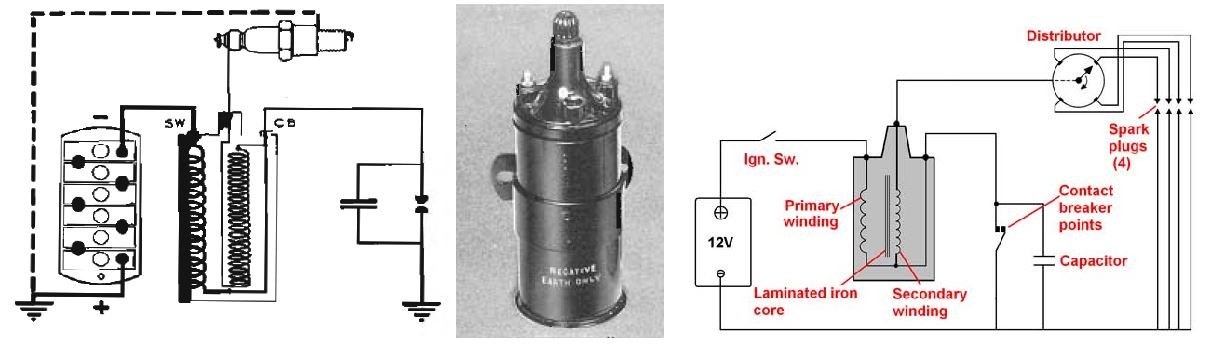
- Coil comparison.JPG (66.72 KiB) Viewed 105644 times
I did the pencil test to confirm that Basil's connections were incorrect some years back. You have to make sure it's a soft pencil, like an HB, to make it easier to see.
This is a freeze frame from a recent video, so not brilliant quality, but you can see the thin blue spark from the lead on the left (a bolt in the lead cap to extend it out) then from the pencil a much broader spark as it pulls carbon with it on the right.
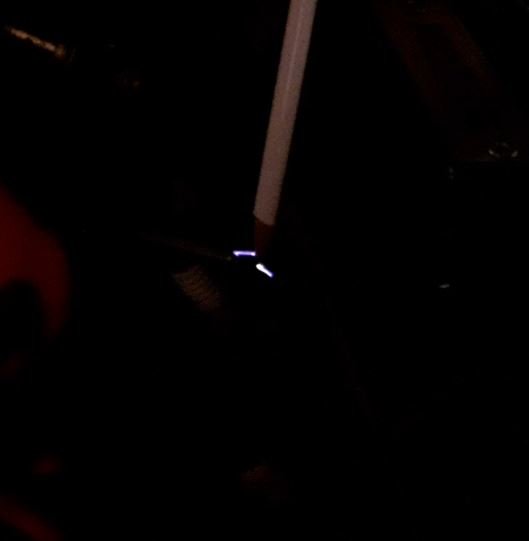
- Pencil test.JPG (10.18 KiB) Viewed 105644 times
(Edited to correct a couple of typos I noticed. I really should stop myself reading my own posts hours after I post them....)