Page 1 of 3
Off with her head!
Posted: Mon Oct 08, 2007 10:04 pm
by alex_holden
Way back when I did the LEO run, I noticed oil leaking from the head gasket at the rear right hand corner (near the distributor). On the way home I happened to notice that when the engine was idling the oil was bubbling slightly as if a small amount of gas was leaking out. She still ran fine so I decided to ignore it.
A thousand miles or so of trouble-free daily commuting passed...
Friday night I resealed the downpipe because it come loose and was making a noise. After I fixed that, the engine still sounded noisier that in should - sort of "clattery."
Saturday morning I drove 250 miles to Glasgow. When I got there the clattering had got louder and the engine was also making odd hissing and popping noises on idle.
Sunday morning I reset the tappets. Some had closed up slightly and some had opened up but none were way out. I then drove 50 miles around the Glasgow area followed by the 250 miles home.
At no point did I notice any loss of power - I was still blatting along the motorway at *coughcough* MPH as per usual, overtaking BMWs and Mercedes. ;)
When I got home the idle was quite rough, and the odd noises were still there. I went to work and back today as normal.
Tonight I finally did a compression test. The results were as follows:
Dry: 130 90 90 95
Wet: 150 115 85 80
Off with her head!
There seems to be evidence of head gasket leakage between all four cylinders. No erosion or missing bits, but there are large black sooty marks on the block and the gasket that weren't there when I fitted the head.
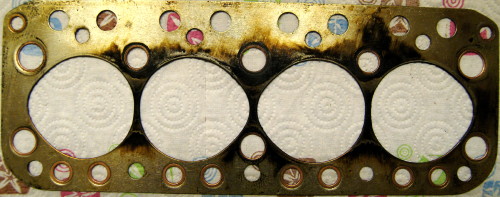
Another odd thing is that although the plugs are pretty clean, there's loads of heavy carbon deposits on the pistons, combustion chambers, and valves. Even the tops of the inlet valves have hard black deposits on them. Everything was spotless when I assembled it and it's only done about 5000 miles since then, much of it at fast motorway speeds!
There's also some very slight pock-marking on the sealing faces of the exhaust valves. I suspect they may not be the hardened "unleaded" type, even though the head was supposedly converted before I bought it. I'm hoping it really does have hardened seats - it's a bit hard to tell.
Any suggestions? I'm considering replacing the exhaust valves with new unleaded ones, I'll definitely clean all the coke off and regrind the valves, and I'm going to borrow a large straight-edge tomorrow to try to check the flatness of the head. I'm wondering whether to try slightly increasing the torque used on the head nuts.
Posted: Mon Oct 08, 2007 10:56 pm
by bmcecosse
Certainly seems to have been running rich if you have all that carbon - and yes - better check the flatness - you need that steel rule with a good light behind it. Check the top face of the block too - remove the studs and slightly countersink each stud hole. Standard head studs can take up to 44 ftlbs torque - and it helps to put a thick washer under each haed nut. If you get the latest head studs - with a little 'Y' stamped on the centre of each stud at one end, then with the later head nuts (which have a wider flat area at one end) you can go to 50 ftlbs. Of course - you need to know if your torque wrench is reading correctly!
As for the ex valves - if they have pitted then they are probably not the 'unleaded' type. Inspect the head to see if indeed it has seat inserts in the exhaust throats - and hopefully they are not pitted!
The compression readings are strange - don't understand why the last two went down after adding oil - maybe the battery was starting to flag ?
Posted: Mon Oct 08, 2007 11:09 pm
by alainmoran
Off Topic, but : How can you test if your torque wrench is reading properly?
Posted: Mon Oct 08, 2007 11:12 pm
by bmcecosse
You could have it checked by an ISO 9001 testing Co - would cost a fortune (in Industry they are re-calibrated once a year) , or try to make a rig with a weight and a known length. Say 40 lbs at 1 foot, and the wrench attached to the other side should just lift the weight without clicking at 41 ftlbs - and should click at 39 ftlbs!
Posted: Mon Oct 08, 2007 11:25 pm
by alainmoran
aaah .. ok .. did you mean that the other way around tho?
Also .. is the angle important? ... ie should the bar with the weight tied to it be hanging vertically or horizontally?
Now to find myself 40lbs worth of weight

Posted: Mon Oct 08, 2007 11:27 pm
by bigginger
Local greengrocer-->sack of spuds? ;)
a
Posted: Mon Oct 08, 2007 11:40 pm
by bmcecosse
Bar (with spuds on end) would need to be horizontal to let gravity do the work against the wrench!
The settings are correct - wrench set at 41 ftlbs will not click when lifting 40 lbs at 1 ft, and will click when set to 39 ftlbs.
Posted: Mon Oct 08, 2007 11:43 pm
by bigginger
I womder if ANYBODY has actually ever done it?
a
Posted: Mon Oct 08, 2007 11:47 pm
by rayofleamington
Or simpler still, you can just hang the weight on your torque wrench!
(e.g. put the square in a vice or on a tight bolt so it won't turn)
Best to hang the weight at the very end to get best resolution, and factor according to the actual length.
You need to know the weight accurately - your household bathroom scales will NOT be anywhere near accurate.
Alternatively, if your company has a calibrated torque wrench then you can test them back to back - that's easiest done against a dial gauge type not a click type.
I checked mine back to back in February as it seemed 'wrong'. It was completely unrepeatable

(sometimes ok and sometimes clicking far too late). I've now got another and vowed not to hit it with the big hammer...
Most torque wrenches sold for DIY can't be 'calibrated' but if you sent it off for calibration, they could tell you if it was faulty!
Posted: Mon Oct 08, 2007 11:48 pm
by bmcecosse
Good idea!!
Posted: Mon Oct 08, 2007 11:56 pm
by alainmoran
Company?
Nope, its just me and Masie the morris here .. and she's about as close as I currently get to a better half

(hence bleeding my brakes being such a chuffer to be sure I got it right)
Heh .. I was thinking of 41lbs weight, rather than 41lbs torque setting, in which case, yep you were absolutley right the first time and it is a LOT simpler your way around to boot!
As far as avoiding it going 'OUT' is there any point in me always being careful to slacken it off to 'no setting' after each time I have used it, or will it just go 'out' of it's own accord?
Posted: Tue Oct 09, 2007 12:02 am
by bmcecosse
It's always suggested it should be slackened off - to take the tension off the spring.
Posted: Tue Oct 09, 2007 9:56 pm
by alex_holden
bmcecosse wrote:Certainly seems to have been running rich if you have all that carbon
The plugs looked fine though - sort of a "tan" colour. The carbon deposits on the pistons were caked on pretty hard; it took ages to scrape it all off.
better check the flatness
Both head and block appear to be flat as best we can tell using a straight-edge.
As for the ex valves - if they have pitted then they are probably not the 'unleaded' type. Inspect the head to see if indeed it has seat inserts in the exhaust throats - and hopefully they are not pitted!
My dad showed one of the valves to a mechanic today and he reckoned the marks were normal, and I couldn't get some new ones locally today anyway so I decided to put it back together after just regrinding them. The seats aren't pitted. As I said it's a bit hard to tell if there are hardened inserts in there - I can just about see a step but that might be where the seat's been machined.
The compression readings are strange - don't understand why the last two went down after adding oil - maybe the battery was starting to flag ?
I don't understand why it did that either, but since the gasket had clearly failed I didn't worry about it too much. The other weird things are that no.1 was so high considering the gasket has been leaking between all four cylinders, and that the engine still had plenty of power on the road despite making funny noises at idle.
alainmoran wrote:How can you test if your torque wrench is reading properly?
I borrowed one for the night from a local garage, and when both were set to 40 lb/ft and connected together they clicked at virtually the same torque. It would be surprising if they were both wrong by the same amount.
Now for the bad news: I almost got it all back together tonight, only for the thread to strip on one of the rocker shaft studs. I think I probably have a spare at work but it was too late to go over for it. Guess who's catching the bus again tomorrow?
Posted: Wed Oct 10, 2007 12:19 am
by MoggyTech
Alec,
That thread that stripped on one of the rocker shaft studs, was it close to the front of the engine? If so, it's a good bet that's what caused the gasket failure in the first place, or rather gasket leak.
Posted: Wed Oct 10, 2007 7:08 am
by Orkney
Sub standard gasket you put on possibly?
Dont seehow you could be running rich given the mpg you get and the speed at which you drive....
Suppose the ost logical way to test for flatness is to have it skimmed?
bad luck there Alex hope you get it sorted.
Posted: Wed Oct 10, 2007 7:40 am
by RogerRust
I can't work out which way round the gasket went when it was on the car.
Did you fit a new waterpump? Is it fouling the head ans stopping it going down tight? or something else at the back?
When I put the 12G940 head on my 948 engine I had to file quite a lot off the water pump to get a good fit and I had to cut the top 12 mm off the engine backplate so that the head would sit down tight.
Just a thought
Roger.
Posted: Wed Oct 10, 2007 7:43 am
by chickenjohn
"was still blatting along the motorway at *coughcough* MPH as per usual, overtaking BMWs and Mercedes. "
Alex, with all due respect- just drive your Morris at 60-65mph maximum cruising speed and you will have no problems. If you really were overtaking fast German cars then the engine must have been screaming at maximum revs at 75-80mph. You will get to your destination maybe 10-15mins later and the engine will be much less stressed for it! ;-) The heads and top of the block get very hot, localised hot spots with extended max revs and any weak point (i.e the head gasket) will suffer and as you saw fail.
"Any suggestions? " No offense intended- drive a bit slower

Posted: Wed Oct 10, 2007 8:32 am
by alex_holden
MoggyTech wrote:That thread that stripped on one of the rocker shaft studs, was it close to the front of the engine? If so, it's a good bet that's what caused the gasket failure in the first place, or rather gasket leak.
No, it was the back one, and I don't see how it could have had an effect as it didn't strip until I reassembled it last night.
Posted: Wed Oct 10, 2007 8:36 am
by alex_holden
Orkney wrote:Sub standard gasket you put on possibly?
I didn't know until Roger just mentioned it that there were two types available - I just bought the standard head gasket set.
Suppose the ost logical way to test for flatness is to have it skimmed?
I'd rather not if I can avoid it.
Posted: Wed Oct 10, 2007 8:39 am
by alex_holden
RogerRust wrote:I can't work out which way round the gasket went when it was on the car.
In the picture, the face you can see is the bottom of the gasket.
Did you fit a new waterpump? Is it fouling the head ans stopping it going down tight? or something else at the back?
Yes, I put a Metro pump on to eliminate the bypass hose. I don't think it's fouling anything but I'll check again tonight.