alex_holden wrote:
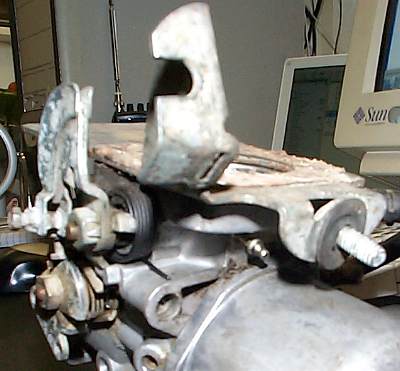
1. Can anyone post a picture of how the choke and throttle cables attach to the bracket? I think there must be a couple of bits missing from mine:
I don't mind making replacement fittings but it would be handy to know what they're supposed to look like first.
I can't post a pic, but you need a spring clip for the choke. You see the slot in the bracket? One end of the clip goes in there, the other end clips over the edge of the bracket, clamping the cable in a raised section. I'm pretty sure the clips are available for around a quid from Minisport and the like.
The throttle cable slides into the hole from the side, and has two large plastic flanges to stop it moving back and forth. I might even have a NOS Mini/ Metro one here, but I'm not sure it'd be long enough for a Minor.
2. What's the stud on the top of the bracket for?
Air filter housing - I'm guessing it's a Metro carb, so there'd be a wing bolt screws through the housing onto the stud normally.
3. Is there supposed to be a separate throttle return spring between the end of the cable and the exhaust clamp like with the HS2 carb, or are the two springs on the butterfly valve shaft sufficient?
There's no extra return spring, the ones on the carb are enough. And they also act rotationally rather than linearly on the spindle, another reason why the HIF is a better carb

4. Does the bracket normally go between the manifold and the spacer, or between the spacer and the carb?
I can't remember for sure, but I'm pretty sure it's manifold, spacer, bracket carb. It's obvious when you fit the cables though as the wrong way makes them look just wrong, IIRC.
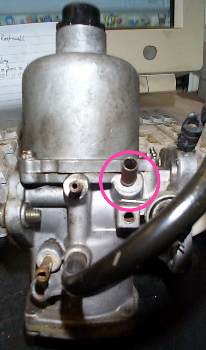
5. Is the connection I've circled in this photo supposed to be piped to the rocker cover breather? If so, is there supposed to be some kind of inline filter in that pipe
Yes, and no. Well, normally it hooks up to the crank (and on 1275s transfer housing) breather system, which have oil/ air seperator cannisters. But it's not a problem to plump the line straight in without seperators, filters etc. I know there's been a lot of debate (OK, arguments) over this, but I'd vent the rocker to atmosphere (running a pipe so the fumes didn't enter the cabin) and blank off the breather inlet on the carb altogether. But unless your engine is breathing very heavily you're not going to be getting critical amounts of oil vapour back into the inlet side of things anyway (the reason this is bad is the warm oil/ air mix ignites too easily, causing knocking and general lack of peak power).
6. Is it normal the angle of the flange on the manifold causes the carb to be tilted towards the engine slightly?
Yes - These carbs are angled slightly on Metros, perfectly normal.
7. Both the carbs are quite dirty and were sold as "unknown condition," but they don't look badly worn. Do you think it's worth fitting full service kits (which cost more than I paid for the carbs), or are they likely to work OK if I just give them a good clean inside and out and oil the linkages?
If the jet looks ovalled then replace, otherwise see how it goes. You'll have the wrong needle anyway, so worry about smooth clean running later
8. I've bought a K&N cone air filter for it (pricey

). It draws air in from all around the cone rather than sucking it from around the exhaust manifold area via a tube - is that likely to cause a problem with carb icing or long warmups in winter?
I hate the cone filters because of the hot air issue. As in they will breath some of the hot air from the exhaust area, as well as the generally warm unbonnet air. Less so than the standard Minor setup I suppose, but still more than is needed. Personally I'd use the Metro filter casing (with a K&N element if I could afford one) and run a cold air feed from the grille to it. So in other words, you shouldn't have a problem at all with icing.
Can't help with WinSU or needle choice, nut I'd throw it together and see how it drove. If you can afford a rolling road session or can get hold of WinSU then all teh better (rolling road being the best), but you can roughly work out the right needle by finding the flat spots and cross referencing on the cspec charts/ lists



 Not that I've ever seen anyway.
