I was also taught to lay them on the side, a very simple habit. I'm always amazed at the response when one points out a mislaid plane. They'll go to to great lengths to defend their actions by saying it's on wood or the blade has been pulled if in storage. Wouldn't it be easier to just lay it on its side? A no thought habit versus an action that requires an active thought process to ensure that the surface is safe.
Wes wrote: ↑Fri Sep 12, 2025 11:03 am
But tut tut I was always taught to rest planes on the sides
Remind me never to fly with you as the pilot
Funny thing is, I did woodwork at school and was never taught this (or can't say I remember) yet the person who tended to teach things like that (not the teacher) would have likely known this.
On the other hand, I do always remember being taught to only use a file in one direction, and it's something I now always notice when ever I see people using files as they pull them back and forth without lifting in the back direction.
———- yes, plane on its side, good practice. However I notice the picture shows the area having a raised edge and the rear of the plane resting on it, keeping the blade off the surface. Maybe we can forgive him !!
Fascinating example of manual craftsmanship in action. Some of these photos are in one of the books on Travellers. The caption was something like "Meanwhile VW were gearing up to produce 1000 cars a day".
No wonder British car manufacture almost went extinct.
And now VW are producing in China as Wolfsburg is on its knees.
Having worked for the Japanese for 6 years in the 1980's I would be happy to explain why the British car industry took such a battering, but there simply isn't room here.
When were the different ways the body was assembled? These pictures show the traveller body assembled to a bare body shell and some other time complete travellers, sans the rear body, were driven to where the rear body was assembled.
jaekl wrote: ↑Sat Sep 13, 2025 12:18 pm
When were the different ways the body was assembled? These pictures show the traveller body assembled to a bare body shell and some other time complete travellers, sans the rear body, were driven to where the rear body was assembled.
Not following you...?
Would these not be the rear bodies, ready to drop onto the drivable chassis?
The last picture with two loaded on a lorry. The underside of the top one clearly shows the Minor floor pan and driveshaft tunnel. It seems at one point in the history of Minors the bare but painted body shell were transported to have the rear body installed before being transported to another location for the final fitment of all equipment.
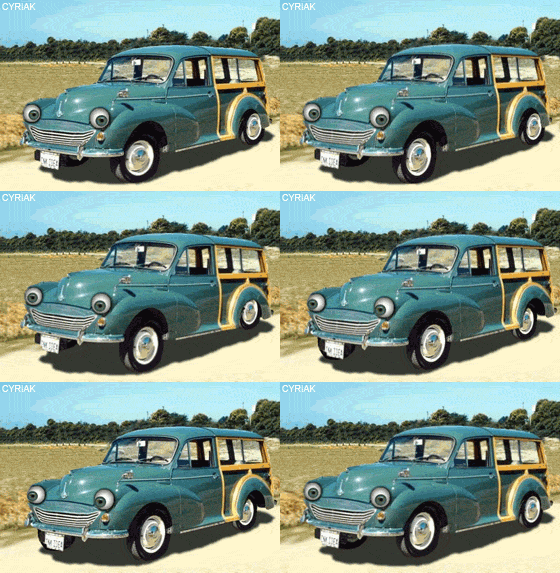
Don't get me wrong, I'm aware of US 'woodies'/ shooting-brakes et al. I love the Traveller really. Would I change it if I could... no. So forgive me.
I reckon it was the same bloke that refused to put his plane right-side up.
Just think and consider for the moment... of all the ways possible to make a car, someone actually said, "I've got a great idea, we'll put wood into the rear frame."
Thing is, out of all things they could have done, they said:
in the late 40's/ early 50's when steel was in short supply timber and alloy probably seemed a good idea, in typical bmc/ leyland style the issue was they were still doing it up until 1970!